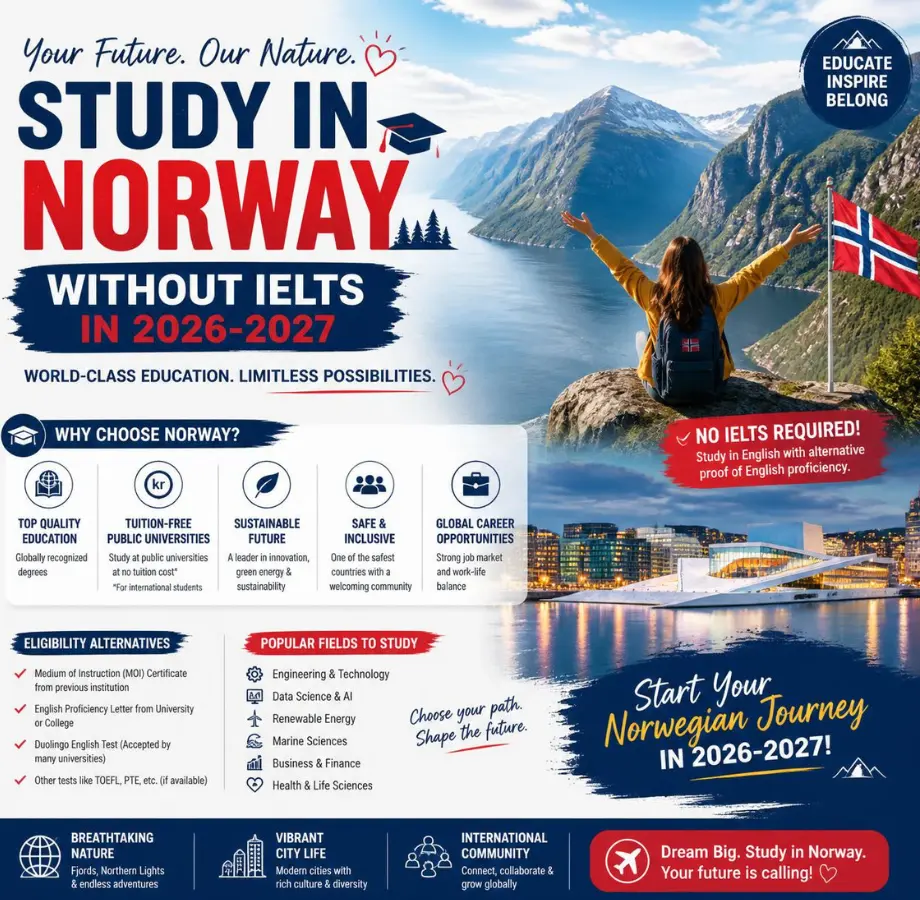
Before anything else, there are two things you deserve to know that most articles on this topic leave out entirely.
First: Norway's public universities are not simply "free for everyone" in 2026. They were, until 2023. Then they weren't. Now they might be again but only at institutions that individually choose to reduce their fees, which not all of them will. If you read anywhere that "Norway charges no tuition to international students," that sentence is either out of date or incomplete. The real situation is more nuanced, and you need to understand it before you apply.
Second: Studying without IELTS in Norway is genuinely possible but the rules differ by university, by level of study, by your nationality, and by what kind of prior education you have. There is no single blanket exemption. What gets someone from Nigeria exempted at the University of Bergen might not satisfy NTNU's requirements, and what works for a Master's application at UiO definitely doesn't work the same way for a Bachelor's.
This guide gives you the accurate picture on both fronts of tuition costs, IELTS exemption rules broken down by institution and circumstance, the scholarships that can cover your costs, and the living expense reality that catches most applicants by surprise.
The Tuition Situation in 2026: What Actually Happened and Where Things Stand
Understanding this history takes five minutes and will save you from a very expensive misunderstanding.
Norway's public universities were tuition-free for all nationalities until 2023, when parliament passed legislation requiring non-EU/EEA students to pay cost-covering fees. "Cost-covering" meant exactly what it sounds like: the full operational cost of your programme, including all direct and indirect institutional expenses. On average, non-EU/EEA students should expect to pay anywhere from NOK 130,000 to NOK 390,000 per year roughly €11,500 to €34,500 annually depending on the institution and field. The consequence was immediate and dramatic. Since the country introduced mandatory tuition fees for non-EU/EEA students in 2023, the number of students starting a full degree dropped by roughly 80 percent. Norway went from being one of Europe's most accessible study destinations to one of its most expensive because high tuition combined with already-high living costs created a total cost of attendance that exceeded many Western European competitors.
The 2026 reversal and its critical caveat:
In a significant development announced in June 2025, Norway's Ministry of Higher Education and Research proposed removing the national requirement for full-cost tuition fees. Under the new framework, individual higher education institutions would gain the flexibility to determine their own fee levels for non-EU/EEA students, including the option to set fees at zero or significantly reduced rates. The change is scheduled to take effect from 1 August 2026, subject to parliamentary approval.
That last phrase "subject to parliamentary approval" is the one every guide is glossing over. And even where the legislation passes, the word "can" is doing a lot of work. The Norwegian government has said that universities "can" set tuition fees to zero for non-EU/EEA students. That's an important word "can." It does not mean "must." It does not mean "will." It means each institution has the legal authority to drop fees if it chooses to, but it is under no obligation to do so.
The University of Stavanger (UiS) has already announced reduced tuition fees, publishing new rates ahead of the legal change to provide predictability for students. Nord University is also planning to reduce fees from the academic year 2026/2027, provided the amendment is approved.
Other institutions have not yet made public commitments.
The practical rule for 2026–2027 applicants: Do not accept an admission offer until you have written confirmation of the tuition fee amount from your specific institution and programme. This is not bureaucratic caution, it's the difference between knowing your actual cost and assuming it based on another university's announcement that doesn't bind your institution at all.
EU/EEA students: none of this applies to you. Students from the EU/EEA can still study tuition-free at public universities, for undergraduate degrees, Master's programmes, and PhDs. The tuition change has been exclusively about non-EU/EEA students.
PhD positions: universally free, always. PhD positions continue to be tuition-free for all nationalities, often accompanied by salaried employment contracts. If your level is doctoral, the tuition question is resolved and Norway's PhD system is one of the most attractive in Europe precisely because you are employed, not just enrolled.
You May Also Like :
Danish Government Scholarships 2027 for Non-EU/EEA Students – Study in Denmark Fully Funded
Portugal Government Scholarships 2027: Fully Funded Opportunities for International Students
What Norway's Public Universities Actually Charge Per Sector (2025–2026 Rates)
To give you a realistic financial baseline while the 2026 changes work through the system:
Norway's strongest disciplines at master's level, all primarily English-taught, are: engineering and marine technology at NTNU; marine science, fisheries and climate at UiB and UiT; renewable energy and offshore safety engineering at UiS in Stavanger; and business and finance at BI Norwegian Business School in Oslo. These fields carry varying tuition rates; engineering and medicine sit at the higher end of the NOK 130,000–390,000 annual range, while humanities and social sciences programmes tend to be lower.
International students applying for a study permit for the 2026–2027 academic year must show proof of at least NOK 170,368 (roughly US$17,399 or approximately €15,900) to cover living expenses for the year. This is separate from tuition; it is the minimum financial proof requirement for the student residence permit, regardless of whether tuition is free or not.
Norway is one of the most expensive countries in Europe, with monthly living costs typically ranging between €1,100 and €1,800. That range roughly €13,200 to €21,600 annually covers accommodation, food, transport, and day-to-day expenses. The lower end applies to smaller university cities; the upper end is realistic for Oslo. This is the number that catches the most applicants off guard, because they focus on tuition and underestimate what it actually costs to live in one of the world's priciest countries.
How the IELTS Exemption Actually Works: University by University
This is where generic guides fail applicants most badly listing "universities that don't require IELTS" as if the exemption is uniform across all programmes, all levels, and all nationalities at each institution. It isn't. Here's what the official rules actually say.
NTNU Norwegian University of Science and Technology
To cover the English language requirement for NTNU's 2025–2026 admissions, applicants must document at least one of the accepted tests: IELTS Academic with a minimum band score of 6.5 on each part of the test; or Cambridge B2 First (minimum grade B), C1 Advanced, or C2 Proficiency; or TOEFL iBT.
Exemptions from the test requirement at NTNU are specific: a passing English grade from Norwegian upper secondary school or Nordic upper secondary education; International Baccalaureate with English at Higher Level (HL) with a minimum score of 4; or for EU/EEA applicants, a certificate from your high school or university documenting that you meet the B2 English language level using the Common European Framework scale. One year of study (60 ECTS) in English at a university level also covers the requirement.
The key constraint for non-EU/EEA applicants: the B2 certificate exemption is EU/EEA-specific. If you are from Nigeria, India, the Philippines, or another non-EU country, you cannot use a university letter stating "English is our medium of instruction" as a standalone exemption at NTNU. You need a recognized test result unless you meet one of the other listed conditions. Only the tests and certificates listed are accepted at NTNU, and other proof of language proficiency cannot be approved.
University of Oslo (UiO)
UiO operates a two-tier system: different rules for Bachelor's and Master's levels, and the Master's requirements are stricter.
For Bachelor's level, the English language requirement is set by HK-dir (the Norwegian Directorate for Higher Education and Skills) and referenced in the GSU list the Higher Education Entrance Qualification for Persons with Foreign Education. The minimum IELTS Academic score for bachelor's admission is 5.0 overall.
For Master's programmes taught in English, the requirements are higher. UiO has a higher requirement for proficiency in English for master's study than stated on the GSU list. Test results must be valid not older than two years on the date of the application deadline. Accepted tests include TOEFL iBT minimum 108 with specific sub-score requirements, and IELTS Academic minimum 5.5 overall with sub-score minimums. From January 21, 2026, the minimum TOEFL iBT score changed to 5.5 with specified minimums across reading, listening, writing and speaking.
The exemption pathway at UiO Master's level: a Bachelor's degree where the language of instruction was English, documented with a diploma supplement or a statement from your university; or a minimum of one year of Master's degree studies (60 ECTS) taught in English. This means an English-medium Bachelor's degree from any country can serve as your language evidence at UiO but you need the diploma supplement or a formal university statement documenting English as the medium, not just a general letter.
University of Bergen (UiB)
For admission to Master's programmes taught in English, UiB requires you to document English language proficiency. For programmes taught in Norwegian, both Norwegian and English proficiency are required.
UiB follows the national framework for English evidence, accepting recognized test scores alongside documentation of prior English-medium education. The specific minimum scores and exemption categories should be confirmed directly with UiB's international admissions office for your chosen programme, as requirements can vary between faculties.
BI Norwegian Business School
BI Norwegian Business School accepts the Duolingo English Test, which makes it one of the more accessible Norwegian institutions for applicants who haven't taken IELTS or TOEFL. The minimum grade required is C or higher for accepted tests. BI is a private institution, which means its admissions policies have more flexibility than the public universities that are bound by national frameworks. If your English proficiency test options are limited, BI is worth investigating specifically.
The Country-Based Exemption System: Who Qualifies Automatically
Norway uses what it calls the GSU list, the national database of foreign education systems to determine which secondary school qualifications automatically satisfy English requirements without a test.
Applicants who have completed at least one year of university or upper secondary education with English as the language of instruction in countries such as the USA, UK, Canada, Ireland, Australia, or New Zealand may be exempt from language test requirements.
Beyond those primary English-speaking countries, the national exemption list covers secondary school certificates from specific African countries. Students who have passed the relevant secondary qualifications from the following countries in the document you shared including Nigeria (Senior School Certificate from 1988 onward, GCE A-level, GCE O-level, WAEC), Ghana (WASSCE, Senior Secondary School Certificate, WAEC), Kenya (Kenya Certificate of Secondary Education from 1989, Advanced Education Certificate), Uganda (Uganda Certificate of Education, Uganda Advanced Certificate of Education), Tanzania (Certificate of Secondary Education East Africa, Advanced Certificate), South Africa (Matriculation Certificate, Senior Certificate), Zimbabwe (GCE O-level, Cambridge School Certificate, GCE A-level), and several others can present these secondary certificates as English language evidence for bachelor's-level applications under the national framework.
The critical distinction: Secondary school certificate exemptions apply primarily to the national bachelor's-level entrance qualification (the GSU list framework). For Master's-level applications at universities like UiO which explicitly sets higher requirements than the GSU list for postgraduate study a secondary school certificate from an exempted country may not satisfy the Master's-level English requirement. At the Master's level, documentation of English-medium university education or an accepted test score is typically what's required.
If you completed your Bachelor's degree entirely in English at a recognized institution, that degree can serve as your language evidence for Master's applications but the specific documentation (diploma supplement showing language of instruction, or a formal university letter) needs to be in place.
The MOI Letter Route: When It Works and When It Doesn't
A Medium of Instruction (MOI) letter from your university is not a universal key that opens every Norwegian university's door. But used correctly at the right institution, for the right level it is a legitimate and accepted route.
Here is the rule of thumb based on the official frameworks above:
It works when your previous degree was at Bachelor's or Master's level, taught entirely in English, and the university you are applying to specifically accepts prior English-medium education as language evidence (UiO Master's, UiB, and others operating under this framework). The letter must state explicitly that the medium of instruction and examination was English, include your enrollment dates and degree details, carry an official university stamp, and ideally include a diploma supplement or transcript showing the language of instruction.
It doesn't work as a standalone document at NTNU for non-EU/EEA applicants, because NTNU's policy specifies that the institutional letter exemption applies specifically to EU/EEA applicants; non-EU students must provide a recognized test or meet one of the other specifically listed conditions.
And it definitely doesn't work if your letter is vague, missing official documentation, or issued by a university that your target institution can't verify. Every Norwegian university that accepts MOI evidence also verifies that a generic email from a departmental secretary will not pass quality review.
Top Scholarships in Norway for International Students 2026–2027
Getting admitted to a Norwegian university is one challenge. Covering your costs particularly the NOK 170,000+ annual living expense requirement is a separate financial challenge that scholarships help address.
PhD Positions at Norwegian Universities Fully Paid Employment
This deserves to go first because it's the most financially complete option available, and it's open to international applicants from every country.
PhD positions at Norwegian universities 2026–2027 are fully funded fellowships where candidates are hired as university employees. They offer salaries, benefits, and tuition-free education, with doctoral opportunities at top institutions like UiO, NTNU, UiB, and UiT attracting researchers worldwide.
A PhD position in Norway is not a scholarship in the traditional sense, it's a salaried job. You receive a monthly salary under a Norwegian employment contract, full Norwegian healthcare and social security benefits, paid annual leave, and tuition-free enrollment in your doctoral programme. The salary for a PhD Research Fellow runs at approximately NOK 532,200 (around €47,000) annually as of 2025 rates. For early-career researchers, this is the single most financially secure pathway to study in Norway at any level, regardless of nationality.
Positions are advertised on individual university websites and on the national database at jobbnorge.no. They are competitive and field-specific; you apply to a specific research project with a specific supervisor, not to a general doctoral programme. No separate scholarship application is needed; the employment contract is the scholarship.
US-Norway Fulbright Grants
The US-Norway Fulbright Foundation offers academic year grants for American graduate-level students, including those pursuing a full master's degree, to study or conduct research in Norway. Up to 12 grants are awarded contingent on funding, and the grant runs 10 months. Norway exempts Fulbright grantees from the tuition fees that apply to other non-EU/EEA students, including for full two-year master's degrees, and grantees also receive a cost-of-living stipend.
The application deadline for the 2027–2028 cycle is October 6, 2026. This is exclusively for US citizens.
NORAM Scholarship Norway-America Association
The NORAM Scholarship fully funds international students who wish to pursue higher education in Norway. The Norway-America Association established this program, which focuses on financial support and cross-cultural exchange. It awards between 30 and 45 grants annually, depending on the funding cycle, and is especially popular for Master's and PhD seekers in science, technology, and humanities. Applications for fall 2026 opened in December 2025.
NORAM is primarily oriented toward Norwegian-American exchange meaning it covers US students going to Norway and Norwegian students going to the US. If you are an American student interested in Norway, this and Fulbright are the two most relevant dedicated scholarship routes.
NTNU Scholarships
NTNU offers fully funded scholarships for international students, including PhD and Master's positions supported by external funding sources. NTNU scholarships often include full tuition waiver, monthly living stipends, health insurance, and travel support. Funding covers various academic fields, with a focus on science, engineering, and technology. Both Master's and doctoral candidates can apply, depending on project needs. NTNU secures funding through partnerships, research grants, and cooperation projects with industry and the EU.
NTNU scholarships are project-specific and not offered through a centralized open call. Monitor NTNU's scholarship pages and faculty job boards for funded positions aligned with your research area.
Erasmus+ Joint Master Degrees
Erasmus+ Joint Master Degrees 2026–2027 in Norway offer fully funded opportunities to study at top universities including the University of Oslo, NTNU, UiB, and UiT. Covering tuition, stipend, travel, and housing, these EU-backed scholarships provide world-class education across Europe.
Several Erasmus Mundus Joint Master programmes are coordinated by or include Norwegian universities as consortium members. The scholarship covers tuition at all consortium institutions including any Norwegian partner plus a monthly allowance, travel costs, and installation support. This is one of the cleanest routes to studying in Norway with full financial coverage for non-EU/EEA students who qualify for the Erasmus Mundus scholarship tier.
BI Presidential Scholarship
BI Norwegian Business School's Presidential Scholarship is a merit-based award targeting outstanding international applicants to BI's full-time Master's programmes. It is particularly relevant given BI's more flexible English proficiency policy (including Duolingo acceptance), making it one of the more accessible scholarship pathways at the Master's level for applicants from outside traditional test-taking markets.
English-Taught Master's Programmes Worth Knowing About
Norway's strongest disciplines at Master's level, all primarily English-taught, include: engineering and marine technology at NTNU (the highest-demand programme category for international applicants from South Asia and Africa); marine science, fisheries and climate at UiB and UiT, where research connects directly to Norway's seafood and ocean energy industries; renewable energy and offshore safety engineering at UiS in Stavanger, positioned for the global energy transition; and business and finance at BI Norwegian Business School in Oslo, which carries strong recognition across Scandinavian corporate networks.
With over 350 English-taught programmes mostly at Master's level, plus Bachelor's and PhD options Norway offers fields spanning engineering, technology, environmental sciences, business, humanities, and more.
A note on Bachelor's-level English-taught programmes: for English-taught Master's and PhD programs, you apply and study in English. For most Bachelor's programs, they are taught in Norwegian, so you must prove Norwegian proficiency to be admitted. If you don't speak Norwegian and are looking for an undergraduate degree, Norway is not the most practical destination. The English-taught pathway is almost entirely at Master's and PhD level.
The Residence Permit and What It Requires
A student visa or residence permit application for Norway requires more than an admission letter. As of the 2025–2026 academic year, students must show that they have at least NOK 166,859 to cover living expenses. This can be demonstrated through a bank statement, a sponsor's letter, or a scholarship confirmation. Proof of secured accommodation in Norway must also be submitted through a rental contract or a letter confirming university housing.
That NOK 166,859 minimum is approximately €15,600 or $17,400. It must be in a verifiable form: a bank statement in your name, a formal sponsor letter meeting UDI's specific requirements, or a scholarship letter from a recognized programme. A general statement of financial support from a family member is not sufficient without the accompanying documentation that UDI specifies.
For PhD positions, this requirement is effectively met by your employment contract; your salary documentation serves as proof of financial means. For scholarship holders, the scholarship confirmation letter serves the same function. For self-funded students, a bank statement showing the balance at the time of application is the standard evidence.
The Practical Application Timeline for Master's Study in Norway
Most English-taught Master's programmes at Norwegian universities follow a fairly consistent calendar:
Applications for the August/September 2027 intake will typically open in October–November 2026. The headline date for most international applicants is around December 1 for the August Master's intake. Non-EU deadlines can be earlier, sometimes November so don't assume December without checking your specific programme.
The application system varies by institution. NTNU, UiO, UiB, UiT, and UiS all run their own portals; there is no centralized master's application system equivalent to the UK's UCAS. You apply separately to each university and programme you want to be considered for.
Documents you need to prepare in advance for every application: degree certificates with official English translations where required, academic transcripts, your English language evidence (test result or MOI documentation), a motivation letter or statement of purpose, and for programmes with strict English test requirements an unexpired language test certificate meeting that programme's specific minimum scores.
The Bottom Line: Should You Apply to Study in Norway in 2026–2027?
The honest answer depends on which profile you fit.
If you are an EU/EEA citizen or a PhD candidate from anywhere in the world: Norway in 2026 is one of the best-value and most financially straightforward study destinations in Europe. Free tuition for EU/EEA students hasn't changed. PhD positions are salaried employment. The quality of research infrastructure, particularly in marine technology, renewable energy, and life sciences, is genuinely world-class.
If you are a non-EU/EEA Master's student with limited scholarship coverage: Norway is significantly more complex than it was before 2023, and the 2026 legislative change improves the picture without fully resolving it. The institutions that reduce fees to zero or near-zero will represent excellent opportunities. The institutions that don't will remain expensive when combined with living costs. Confirm the fee in writing before committing.
If you are looking to avoid IELTS: Norway is a realistic option, but your exemption route depends on your specific background, nationality, and target institution. The exemption is not a shortcut; it requires the right documentation, issued correctly, meeting the specific requirements of your chosen university. Do the verification work before applying, not after.
You May Also Like :
Danish Government Scholarships 2027 for Non-EU/EEA Students – Study in Denmark Fully Funded
Portugal Government Scholarships 2027: Fully Funded Opportunities for International Students
Ready to Apply?
Gather your documents and apply through the official website.
Apply on Official WebsiteNo application fee required through our portal.